Every industry in Virginia
- Manufacturing & Industrial · $100K–$1.5M
- Law Firms · $50K–$1.2M
- Medical Practices & Health Systems · $80K–$820K
- Accounting & Tax Firms · $25K–$865K
- Construction Companies · $115K–$1M
- Software Companies · $50K–$500K
- Consulting & Advisory Firms · $150K–$300K
- Investment Firms · $50K–$800K
- Digital Health Companies · $100K–$900K
- Insurance Agencies · $100K–$400K
- Game Studios · $100K–$1M
- Publishers & Education Companies · $35K–$370K
- Call Centers & BPO · $20K–$250K
- Consumer Brands & Photo Studios · $30K–$800K
- Cybersecurity Companies · $20K–$750K
- Design & Web Agencies · $20K–$890K
- Payments & Fintech Companies · $80K–$900K
- Biotech & Life Sciences · $50K–$875K
- Hardware Engineering Companies · $45K–$1.3M
- Hedge Funds & Quant Firms · $25K–$1.1M
Top counties in Virginia
- Manufacturing & Industrial: Fairfax (332)
- Law Firms: Fairfax (8,591)
- Medical Practices & Health Systems: Fairfax (3,709)
- Accounting & Tax Firms: Fairfax (8,591)
- Construction Companies: Fairfax (2,470)
- Software Companies: Fairfax (849)
- Consulting & Advisory Firms: Fairfax (8,591)
- Investment Firms: Fairfax (1,629)
- Digital Health Companies: Fairfax (3,709)
- Insurance Agencies: Fairfax (1,629)
Top county by establishments for each trade. Source: Census County Business Patterns, 2022.
Virginia at a glance
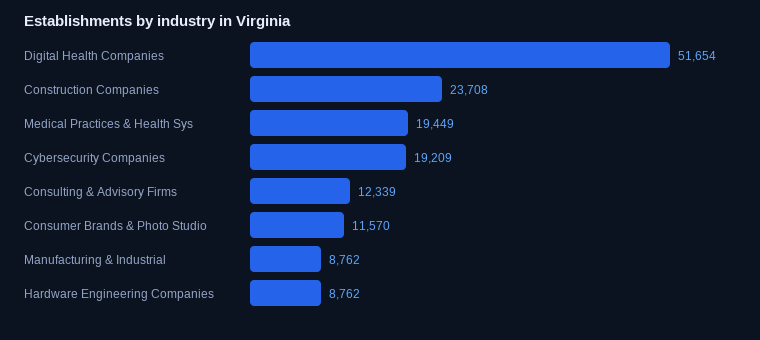
The local base in Virginia
- Manufacturing & Industrial: 8,762 establishments, 243,842 employees
- Law Firms: 4,863 establishments, 25,216 employees
- Medical Practices & Health Systems: 19,449 establishments, 214,241 employees
- Accounting & Tax Firms: 4,344 establishments, 39,669 employees
- Construction Companies: 23,708 establishments, 213,502 employees
- Software Companies: 6,370 establishments, 70,022 employees
- Consulting & Advisory Firms: 12,339 establishments, 90,765 employees
- Investment Firms: 3,230 establishments, 14,338 employees
- Digital Health Companies: 51,654 establishments, 475,961 employees
- Insurance Agencies: 5,283 establishments, 56,542 employees
- Game Studios: 6,370 establishments, 70,022 employees
- Publishers & Education Companies: 6,370 establishments, 70,022 employees
- Call Centers & BPO: 1,399 establishments, 25,913 employees
- Consumer Brands & Photo Studios: 11,570 establishments, 113,966 employees
- Cybersecurity Companies: 19,209 establishments, 174,481 employees
- Design & Web Agencies: 946 establishments, 2,291 employees
- Payments & Fintech Companies: 4,825 establishments, 72,415 employees
- Biotech & Life Sciences: 1,542 establishments, 29,531 employees
- Hardware Engineering Companies: 8,762 establishments, 243,842 employees
- Hedge Funds & Quant Firms: 3,230 establishments, 14,338 employees
Source: BLS QCEW, 2023 annual averages.
What stays the same
No data moves until you sign. The buyer pays you. The published band is a ceiling, not an offer.
Virginia companies are eligible for US buyer programs when the records and rights fit.
The Virginia business base runs on technology, defense, logistics and healthcare, and those are the teams in Virginia most likely to hold records a buyer wants.
Does licensing mean giving up ownership?
Virginia companies can discuss licensing without treating ownership as something they must give away. Licensing data does not have to mean transferring ownership. The proposed agreement should separate permission to use the data from ownership of it. That distinction gives the reader a direct question to ask: what rights would a buyer receive, and which rights would the company keep after the agreement ends?
Contracts and permissions matter before a company offers records for licensing. Holding data is not the same as having permission to license every part of it. Records may contain material supplied by other parties or information covered by existing restrictions. The ownership discussion should identify what the company controls, what needs further review, and what must stay outside the proposed dataset before any delivery is agreed.
What would a buyer receive?
A buyer would receive the agreed dataset and the permissions specified in the license. The description should make that package concrete: which records are included, what fields they contain, how they are organized, and what supporting explanations accompany them. It should also distinguish a defined delivery from any proposed ongoing access. Neither access to company systems nor future updates should be left for either party to assume.
Delivery details should explain what the records represent and where their usefulness ends. Virginia’s technology, defense, and port logistics clusters provide context, but a sector label does not describe a dataset. The proposed package should identify its source, coverage, omissions, and any changes made before delivery. Those details help a buyer understand the material without confusing a company’s broader operations with the specific data being offered.
Check a range before sharing files
Treat the published band as a ceiling, not a forecast. It does not predict what a buyer will offer or establish that a sale will happen. Reading the upper end as expected revenue would give the band a meaning it does not have. Keep that distinction clear when discussing a possible license internally.
Use the calculator to check a range as the next step. No files are uploaded for this check. Keep the result alongside a plain description of the data you might offer and the ownership questions still to resolve. The range is a starting point for considering the opportunity, with the published ceiling kept separate from any expectation of proceeds.
Where these numbers come from
Establishment and pay counts come from BLS QCEW 2023 annual averages and Census County Business Patterns 2022. The published band is what buyers list.
The median confirmed sale in this market sits well below the top of that band. Treat the range as a ceiling, not a forecast.
Questions
Which industries qualify in Virginia?
Any industry on the list for Virginia can qualify when the company has the records, years and rights a buyer wants.
Do I have to be a tech company?
No. Manufacturers, law firms, medical practices and construction companies in Virginia qualify when the records and rights fit.
Does it cost anything?
Most buyers charge the company nothing. A broker is paid only if a deal closes.
How large is Virginia’s population?
Virginia has about 8.7 million people.
Which Virginia metros are highlighted?
The highlighted metros are Richmond, Northern Virginia, and Norfolk.
How large is Virginia’s cybersecurity business base?
Cybersecurity companies account for 19,209 establishments and 174,481 employees.