Every industry in North Carolina
- Manufacturing & Industrial · $100K–$1.5M
- Law Firms · $50K–$1.2M
- Medical Practices & Health Systems · $80K–$820K
- Accounting & Tax Firms · $25K–$865K
- Construction Companies · $115K–$1M
- Software Companies · $50K–$500K
- Consulting & Advisory Firms · $150K–$300K
- Investment Firms · $50K–$800K
- Digital Health Companies · $100K–$900K
- Insurance Agencies · $100K–$400K
- Game Studios · $100K–$1M
- Publishers & Education Companies · $35K–$370K
- Call Centers & BPO · $20K–$250K
- Consumer Brands & Photo Studios · $30K–$800K
- Cybersecurity Companies · $20K–$750K
- Design & Web Agencies · $20K–$890K
- Payments & Fintech Companies · $80K–$900K
- Biotech & Life Sciences · $50K–$875K
- Hardware Engineering Companies · $45K–$1.3M
- Hedge Funds & Quant Firms · $25K–$1.1M
Top counties in North Carolina
- Manufacturing & Industrial: Mecklenburg (774)
- Law Firms: Wake (5,657)
- Medical Practices & Health Systems: Mecklenburg (3,692)
- Accounting & Tax Firms: Wake (5,657)
- Construction Companies: Wake (3,233)
- Software Companies: Mecklenburg (706)
- Consulting & Advisory Firms: Wake (5,657)
- Investment Firms: Mecklenburg (2,618)
- Digital Health Companies: Mecklenburg (3,692)
- Insurance Agencies: Mecklenburg (2,618)
Top county by establishments for each trade. Source: Census County Business Patterns, 2022.
North Carolina at a glance
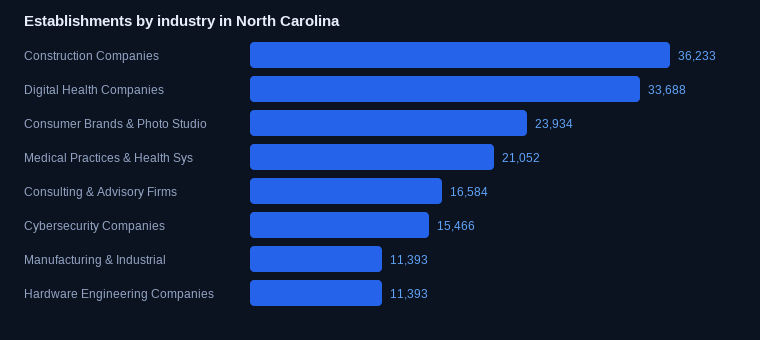
The local base in North Carolina
- Manufacturing & Industrial: 11,393 establishments, 469,557 employees
- Law Firms: 5,701 establishments, 28,121 employees
- Medical Practices & Health Systems: 21,052 establishments, 237,297 employees
- Accounting & Tax Firms: 5,718 establishments, 31,525 employees
- Construction Companies: 36,233 establishments, 261,427 employees
- Software Companies: 10,125 establishments, 85,045 employees
- Consulting & Advisory Firms: 16,584 establishments, 63,906 employees
- Investment Firms: 5,966 establishments, 33,014 employees
- Digital Health Companies: 33,688 establishments, 554,244 employees
- Insurance Agencies: 7,354 establishments, 78,197 employees
- Game Studios: 10,125 establishments, 85,045 employees
- Publishers & Education Companies: 10,125 establishments, 85,045 employees
- Call Centers & BPO: 2,207 establishments, 21,867 employees
- Consumer Brands & Photo Studios: 23,934 establishments, 208,586 employees
- Cybersecurity Companies: 15,466 establishments, 74,405 employees
- Design & Web Agencies: 1,748 establishments, 4,777 employees
- Payments & Fintech Companies: 6,154 establishments, 116,352 employees
- Biotech & Life Sciences: 2,553 establishments, 35,854 employees
- Hardware Engineering Companies: 11,393 establishments, 469,557 employees
- Hedge Funds & Quant Firms: 5,966 establishments, 33,014 employees
Source: BLS QCEW, 2023 annual averages.
What stays the same
No data moves until you sign. The buyer pays you. The published band is a ceiling, not an offer.
North Carolina companies are eligible for US buyer programs when the records and rights fit.
The North Carolina business base runs on manufacturing, finance, technology and agriculture, and those are the teams in North Carolina most likely to hold records a buyer wants.
Ownership and permission come first
Licensing company data does not have to mean giving up ownership. The proposed agreement should distinguish ownership from the uses a buyer would receive permission to make. If keeping ownership is a requirement, state that before discussing delivery. Make the permitted uses clear enough to assess against that requirement before proceeding.
Before offering a dataset, check whether your company can authorize its proposed use. Possessing records is not the same as having permission to license everything within them. Review relevant agreements and restrictions, including material supplied by others. Leave out anything whose ownership or permitted use remains unclear until those questions are resolved.
What a buyer receives
A buyer should receive a defined dataset and a clearly described license to use it. The offer should identify the included records, their format, and any accompanying documentation. It should also explain exclusions. This gives both sides something concrete to review before agreeing on access, delivery, or permitted AI training uses.
Delivery terms should explain whether the offer covers an existing collection or includes later updates. Documentation should describe what the fields mean and how the records were collected. Treat these as details to agree, rather than promises made by this page. The proposed package should make its contents and limits understandable.
The published band is a ceiling
Treat the published band as a ceiling, not a forecast. It does not tell you what your company will earn or establish that a buyer will make an offer. Keep that distinction visible when reviewing a calculator result. A displayed range should not become an expected sale price in your planning.
North Carolina’s business base includes manufacturing, finance, technology and agriculture. That context describes the state, but it does not establish demand for your particular records. The establishment and employment figures on this page describe business activity. They do not show that your dataset qualifies for licensing or that a transaction will happen.
Check a range with the calculator
Use the calculator to check a range as your next step. No files are uploaded during this check. Read the result with the ceiling distinction in mind, then decide whether further review is worthwhile. You can explore the range before preparing a dataset for delivery or discussing specific terms with a buyer.
Keep the result alongside a plain description of the data you might offer. Note what the collection contains, where it came from, and which permission questions need answers. This gives you a useful starting point for further review. Checking a range does not settle ownership, define the final package, or promise a sale.
Where these numbers come from
Establishment and pay counts come from BLS QCEW 2023 annual averages and Census County Business Patterns 2022. The published band is what buyers list.
The median confirmed sale in this market sits well below the top of that band. Treat the range as a ceiling, not a forecast.
Questions
Which industries qualify in North Carolina?
Any industry on the list for North Carolina can qualify when the company has the records, years and rights a buyer wants.
Do I have to be a tech company?
No. Manufacturers, law firms, medical practices and construction companies in North Carolina qualify when the records and rights fit.
Does it cost anything?
Most buyers charge the company nothing. A broker is paid only if a deal closes.
Which business clusters are highlighted in North Carolina?
Manufacturing, banking and technology are the highlighted clusters.
Which North Carolina metros are listed?
Charlotte, Raleigh and Greensboro are the listed metros.
Which regulator is identified for North Carolina?
NC DEQ is the identified regulator.