Every industry in New Jersey
- Manufacturing & Industrial · $100K–$1.5M
- Law Firms · $50K–$1.2M
- Medical Practices & Health Systems · $80K–$820K
- Accounting & Tax Firms · $25K–$865K
- Construction Companies · $115K–$1M
- Software Companies · $50K–$500K
- Consulting & Advisory Firms · $150K–$300K
- Investment Firms · $50K–$800K
- Digital Health Companies · $100K–$900K
- Insurance Agencies · $100K–$400K
- Game Studios · $100K–$1M
- Publishers & Education Companies · $35K–$370K
- Call Centers & BPO · $20K–$250K
- Consumer Brands & Photo Studios · $30K–$800K
- Cybersecurity Companies · $20K–$750K
- Design & Web Agencies · $20K–$890K
- Payments & Fintech Companies · $80K–$900K
- Biotech & Life Sciences · $50K–$875K
- Hardware Engineering Companies · $45K–$1.3M
- Hedge Funds & Quant Firms · $25K–$1.1M
Top counties in New Jersey
- Manufacturing & Industrial: Bergen (1,003)
- Law Firms: Middlesex (4,073)
- Medical Practices & Health Systems: Bergen (4,090)
- Accounting & Tax Firms: Middlesex (4,073)
- Construction Companies: Bergen (2,737)
- Software Companies: Bergen (541)
- Consulting & Advisory Firms: Middlesex (4,073)
- Investment Firms: Bergen (1,535)
- Digital Health Companies: Bergen (4,090)
- Insurance Agencies: Bergen (1,535)
Top county by establishments for each trade. Source: Census County Business Patterns, 2022.
New Jersey at a glance
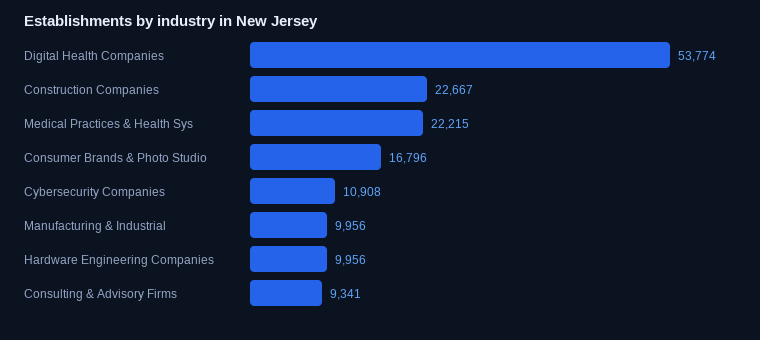
The local base in New Jersey
- Manufacturing & Industrial: 9,956 establishments, 252,317 employees
- Law Firms: 5,895 establishments, 36,447 employees
- Medical Practices & Health Systems: 22,215 establishments, 258,322 employees
- Accounting & Tax Firms: 4,451 establishments, 42,767 employees
- Construction Companies: 22,667 establishments, 164,963 employees
- Software Companies: 5,968 establishments, 77,920 employees
- Consulting & Advisory Firms: 9,341 establishments, 59,533 employees
- Investment Firms: 3,935 establishments, 44,347 employees
- Digital Health Companies: 53,774 establishments, 626,286 employees
- Insurance Agencies: 4,405 establishments, 74,882 employees
- Game Studios: 5,968 establishments, 77,920 employees
- Publishers & Education Companies: 5,968 establishments, 77,920 employees
- Call Centers & BPO: 1,643 establishments, 17,546 employees
- Consumer Brands & Photo Studios: 16,796 establishments, 214,442 employees
- Cybersecurity Companies: 10,908 establishments, 80,802 employees
- Design & Web Agencies: 992 establishments, 3,926 employees
- Payments & Fintech Companies: 4,918 establishments, 70,943 employees
- Biotech & Life Sciences: 1,302 establishments, 35,797 employees
- Hardware Engineering Companies: 9,956 establishments, 252,317 employees
- Hedge Funds & Quant Firms: 3,935 establishments, 44,347 employees
Source: BLS QCEW, 2023 annual averages.
What stays the same
No data moves until you sign. The buyer pays you. The published band is a ceiling, not an offer.
New Jersey companies are eligible for US buyer programs when the records and rights fit.
The New Jersey business base runs on pharmaceuticals, finance, logistics and healthcare, and those are the teams in New Jersey most likely to hold records a buyer wants.
Licensing data and keeping ownership
Selling access to company data does not have to mean transferring ownership of that data. A license can give a buyer permission to use an agreed dataset while your company keeps ownership. The agreement should explain permitted uses, restrictions, and whether your company can license the same material to someone else.
Before offering a dataset, check what your company actually controls. Having records in a company system does not, by itself, settle permission to license everything they contain. Review where the material came from and any agreements attached to it. Identify content involving employees, patients, or other parties before deciding what to offer.
What a buyer receives
What a buyer receives should be defined as a specific package: the agreed data, an explanation of its contents, and permission for stated uses. Describe the fields, formats, source, and coverage. Make clear whether the offer concerns an existing collection or includes updates, so the delivery matches the permission being sold.
Access also needs a clear boundary. An offer should explain how a buyer would receive or use the agreed material, without implying access to every company system. Separate included records from excluded information. State what supporting documentation would accompany delivery and which questions about quality or completeness still need an answer.
The published band is a ceiling
The published band is a ceiling, not a forecast. It does not predict what your company will receive or promise that a buyer will make an offer. Treat it as an upper boundary for the page’s estimate. Any discussion of a particular dataset still needs its scope, permissions, and contents established.
New Jersey’s business base includes pharmaceuticals, finance, logistics, and healthcare. Those sectors provide context for this page, but sector size does not establish the value of an individual dataset. The supplied figures list 53,774 Digital Health Companies establishments and 626,286 employees. Neither figure tells you what a buyer would pay for your records.
Check a range with the calculator
Use the calculator to check a range for your company’s data. No files are uploaded for this step. Start with a description of the material you may be able to license. Keep the proposed scope clear enough to distinguish an available dataset from records that still need an ownership or permission review.
Keep the result as a starting point for deciding whether to investigate further. A calculator range cannot establish ownership, confirm permission, or show that a buyer wants the material. After checking it, identify the questions you need to resolve about your dataset before preparing any files or considering a specific offer.
Where these numbers come from
Establishment and pay counts come from BLS QCEW 2023 annual averages and Census County Business Patterns 2022. The published band is what buyers list.
The median confirmed sale in this market sits well below the top of that band. Treat the range as a ceiling, not a forecast.
Questions
Which industries qualify in New Jersey?
Any industry on the list for New Jersey can qualify when the company has the records, years and rights a buyer wants.
Do I have to be a tech company?
No. Manufacturers, law firms, medical practices and construction companies in New Jersey qualify when the records and rights fit.
Does it cost anything?
Most buyers charge the company nothing. A broker is paid only if a deal closes.
Which New Jersey metros are highlighted?
Newark, Trenton, and Camden are the highlighted metros.
Which business clusters are highlighted?
Pharmaceuticals, port logistics, and finance are the highlighted clusters.
Which regulator is listed for New Jersey?
NJDEP is the listed regulator.